Wednesday, 2 July 2014

Paris VIII

The Perfect Saturday in Paris 
11am-5am

11am Paris 1900, Le Petit Palais


M and I began our whirlwind saturday by wandering from the tranquil setting of the rose gardens of Le Petit Palais to the buzz of the hotly anticipated Paris 1900 exhibition; a time - we are reminded - where electricity was the least of the magic on offer.  The first room, which took our fancy was Le Myth de la Parisienne. The cultural explosion, the liberation of the classes, the wild hedonism can all be perceived as you are immersed in a blend of film, posters and frivolous paintings. Social changes are highlighted by the way the lower classes are just as involved in fashion as the aristocratic women. 


 The first room, which took our fancy was Le Myth de la Parisienne. The cultural explosion, the liberation of the classes, the wild hedonism can all be perceived as you are immersed in a blend of film, posters, sculpture and paintings.


We wanted to wrap ourselves in every piece of clothing, from the delicate, diaphanous lace to the flattering feminine silhouettes and the enthralling romance of the ethereal pieces. It made us look down at our dusty, black doc martins in utter despair. There are more swirls of romance in the images of beautiful girls in their 'robes aux dentelles' in Paris par La Nuit as they're swept off their feet by dashing gentlemen in elegant smoking jackets. You are taught that it was not only art, but the changing fashion that held the spotlight at the turn of the century.


M and I discussed how we found Paris par La Nuit the most captivating theme, because it was so refreshing to see the liberation of young wealthy Parisian women alongside bourgeois representations of les cocottes - the prostitutes - splashed across the iconic posters. Overall, Paris 1900 provided an interesting snapshot of the time, but sadly the curation was messy. The art was also unnecessarily crammed in resulting in overwhelming huddles of snap-happy tourists around each piece combined with many works being too high to properly inspect.


If it were me, I would have handpicked a smaller cross section of the work. Exceptionally overhyped, it was like the Le Petit Palais bypassed hiring a curator and simply emptied out their attic for public indulgence. I would really recommend that you go and see Bill Viola, Robert Mapplethorpe or Monumentaux at Grand Palais across the street first and if you STILL have energy after all three, then perhaps it's worth queuing for Paris 1900. The fashion in Le Myth de la Parisienne and the playful history of Les Cocottes in Paris par la nuit are the only stimulating sections.

1pm Josephine, Musee de Luxembourg
"Je sens que je n'étais pas née pour tant que de grandeur". 


M and I's dream girl the Empress Josephine was Napoleon's great love and eventually a popular Queen of Italy. She was known for her beauty, her graceful movements and her sympathetic personality. As with Marie Antoinette, she maintained a luxurious court whilst being a promoter of the arts; supporting growing textile industries as well as pursuing her passion for jewelry and it's intricate design. L'ancien regime was a fashion conscious time where the decorative arts were important and she was at the forefront. If I could live in the life of a historical figure for a day, it would be certainly be that of Josephine or Marie Antoinette.


As she famously said, "l'art et la botanique seront mes occupations." Hailing from Martinique, she also had a passion for travel and collected artistic, opulent pieces of art and furniture along the way. As a true polymath, she was equally infatuated by the botanical sciences and nature, which is fitting given that Pierre Paul Prud'hon painted her most famous portrait in the garden of Malmaison. But, sadly this blissful life was not to last, because her greatest fears were realised when Napoleon eventually abandoned his childless wife in favour of the fertile Marie Louise of Austria.


What makes this exhibition so magical is how truly immersed you feel in the life and loves of this iconic woman. With beautifully written descriptions for each area and piece, you feel carried through her life on a chariot of knowledge. Furthermore, what is so unique is the way that the Musee de Luxembourg goes beyond the endless portraits of Josephine by presenting a range of the possessions she surrounded herself with from intricately sewed lace dresses to her mesmerizing collections of diamonds and eccentricities from her opulent collections of tea sets to the exact ring she was given as a coronation gift.


 When you trace your finger across the legal record of her baptism, you know that the museum's attention to detail is near perfect. The ambience of the space is heavenly thanks to the muted grey of the walls and simple gold finish lining the ceiling, which let the colour palettes of the work speak for themselves. In contrast, at Versailles the day before, we had to piece together any past memories of films or literature on the subject of our heroine Marie Antoinette to understand the space, but at Musee de Luxembourg it felt effortless - you couldn't help but leave feeling like Josephine was an intimate friend. 

3pm Francois Huguier 
Pince-moi, je reve
Maison Europeenne de la Photographie 


Despite the weekend's horrific rainstorms, we naively thought we'd be terribly ambitious and smugly headed off the the grand Mosque of Paris for a more alternative dose of culture. However, as symptomatic of many cultural experiences in Paris, it was closed to visitors for nothing more than a random lunch break and we were quite honestly shooed out of there like rats in the subway. Not very friendly. So, we crossed the Seine to Le Marais for some bargain hunting in my beloved 1euro bins on the infamous Rue de la Verriere after a little more art. 


BUT, first we saw Francois Huguier's interpretation of un monde reve (a dream world) through an eclectic blend of quirky portraiture, hard-hitting photojournalism and travel photography at the fabulous Maison Europeene de la Photographie. 


From -40 in Siberia to +40 in Africa, her work is magical, but can only be adequately described by actually viewing the works. But, what is key to the retrospective is that she really involves herself in her subject's lives and you can sense that intimate connection in her portraits. We lovers of opulence also adored the building with its seemingly infinite twisting staircase and chandeliers. 


Katia Maciel's work also drew us in - especially relaxing beneath this projection. Pure escapism truly  comes from the temporal echoes she displays in her work. The beach may be simple, but it's effective - the water running along the floor makes you jump. I've learnt in Paris that I am always most peaceful when I sit in an art gallery surrounded by work and quietly ponder the visual experience. The paradox between the tranquility of sitting idle amongst the hard working art intensifies the atmosphere. Be it, the distant vibrations of music or absolute silence - there is no better place to let yourself slip into a hypnotic, deeper level of relaxation.


5pm Vintage in Le Marais


Anyone who knows me well will be all too aware of my endless collections of vintage velvet jackets, colourful fur coats and most recently a pair of red velvet dungarees (all of which i've picked up in Paris for a euro a piece). Beware that you'll have to eat your weetabix, because it is hard, manual labour sifting through all the boxes in the low lit back rooms (with frustrating blue filters to further reduce sight). But, as they say removing a sense, intensifies the others, so the trick is to search for the texture of the material before the outrageous pattern; velvet, velvet, velvet! 

Vintage Bar, 16 Rue de la Verriere
Frip-irium, 2 Rue de la Verriere
The King of Frip, 33 Rue de Sicile


We then went on for frozen yogurt with coconut shavings at the Yogurt Factory behind the Pompidou and sheltered from the rain on a stoop, just savouring the moment. M and I lived together in New York and now that we find ourselves together in Paris once again, frozen yogurt is far more suitable for celebrations than a flute of champagne could ever be.


8pm Artazar party, 
83 Quai de Valmy


If you love flicking through coffee table art books or art magazines, Canal St Martin's Artazar will be your dream come true. They sell anything from dusty pink polaroid cameras, to Patti Smith's life work to swirling books of intricate patterns to sew from. I've often found myself sitting cross-legged, buried under copies of Wonderland, Lula and Polka finding hours of pleasure have ticked by. The wonder of Artazar is that like most other establishments lining the Canal it is also a community base and on thursday night they hosted a party with flowing rose for us all to enjoy. Despite the approaching storm, the ambience was so warm and friendly as everyone mingled; from the starving artists coming down from Belleville to the Bobos of Rue Beaurepaire. 


9pm Dinner at Café Pinson, 
28 Rue du Faubourg Poissonniere


Our navigation led us down Rue Paradis to the vegan dream, Cafe Pinson. This little hotspot is the sister of Le Marais' more casual cafe, but is less crowded and has an ever so sultry atmosphere during the evening. The counter is lined with tempting jars of fresh quinoa granola, vegan peach crumble and chocolate cakes, which make you want to forget about the creative approach to vegan main courses that you trekked there for.


 We were terribly well disciplined and shared a little rainbow salad and a soya omelette with grilled tomatoes and the most delicious lime salsa before diving into absolutely exquisite peach crumble and fresh strawberries with their homemade granola and soya yogurt. The food was out of this world, but the highlight was the fact that we were seat in a cosy wrap around sofa in the corner, where we could pull up our feet and eat by candlelight with our bowls in our laps. And, they don't charge you for extra bowls of sauce, tasting granola or even more yogurt - thank you! 

1130pm Canal drinks to Le Comptoir General 


My final night of living on Canal St Martin before moving to the stiffer quartier of St Germain was dreamy. M and I  bought bottles of red wine to perch opposite the colourful shopfronts of Antoine & Lilli. Despite the lack of sunshine, spirits were not dampened and an eclectic group of friends trickled in until there were about 16 of us lounging on the banks, ready to go for a dance and a rum punch at the ghetto museum/speakeasy Le Comptoir General.


If I could recommend one place to go in Paris, it would be this eclectic bar with its gardens, its attics and its curious maze of rooms where you can either sprawl across a velvet sofa, grabs some carribean food at a picnic table, dance in front of a juke box or even get your fro trimmed at the salon. There is no end to the madness and should you tire of the friend you arrived with the atmosphere is like that of a cosy house party, where everyone mingles with everyone, because only the truly curious, adventurous souls dare to enter. Fresh ginger juice cocktails or big bottles of mango punch are the top choice for watering down your nibbles.


2.30am Le Carmen, Pigalle


Again, I have already posted about this Rococo dream of a nightclub in Pigalle, but you absolutely must go, because there is no closer expeierence to have a house party in Versailles or disco-dancing through Buckingham Palace.


Wednesday, 25 June 2014

Paris VII (Robert Mapplethorpe)

Learning about love (Patti Smith) at 
Robert Mapplethorpe's Retrospective 


The Robert Mapplethorpe retrospective at Grand Palais has truly ignited my obsession with his life long love affair with the elusive icon - and author of Just Kids - Patti Smith. It is an enthralling story of unconditional friendship, which goes deeper than sex, co-habitation or even fidelity. Above all, they bonded through their work and felt by magnified by the other in every aspect of their lives.

Mapplethorpe was born into a Catholic family in Queens; his religious upbringing is referenced throughout the exhibition as with the stirringly nihilistic piece, Christ 1988, which juxtaposes his somewhat obscene pornographic imagery. 


Tragedy struck when his successful career was cut short by his 1986 AIDS diagnosis and premature death. The disease is an important theme throughout the exhibition as is the atmosphere in New York and how the liberation of sexuality was perceived. He underlines this by saying that, “these pictures could not have been done at any other time”. 


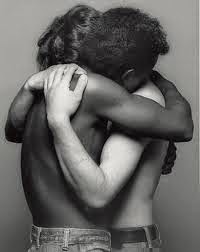
By 1969 he had moved into the Chelsea hotel with other emerging artists like Patti Smith and began using controversial homosexual imagery in his work. My favourite two pieces illustrating this were Two men dancing – in which they intimately sway in unison, naked except for the crowns on their heads – and the simplistic Embrace, 1982 which shows the embrace of a black man and a white man thus defying the crippling racism that burdened the States. 


 In 1973 Mapplethorpe hosted his first Polaroid exhibition at the Light Gallery, but he was always very clear that he considered his work to be works of art before photography. The 1983 self-portrait with a knife symbolises the provocative nature of work. In 1983 he and Andy Warhol produced portraits of each other, which captured the pair's shared mission to truthfully record the atmosphere of 1980s New York. Like Warhol he captured the burgeoning cult of celebrating in images like his Calvin Klein-esque portrait of Richard Gere – now known to us as the Pretty Woman sex symbol – in a simple pair of blue jeans.


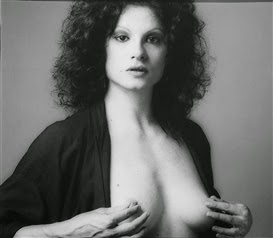
There was a certain depth of emotion, entwined in every piece. Be it attributed to his close relationships with his subjects or his passion for the aesthetic perfection of anything from the human body to flowers, the night to sexuality. As he declared, “I have boundless admiration for the naked body, I worship it”. Visibly, the influence of classical sculpture was strong and he admired the Renaissance master Michelangelo’s use of muscular physiques in his work, which led him to take the world bodybuilding champion Lisa Lydon as his muse. The 1982 portrait of her holding her nipples with a confrontational gaze towards the audience is symptomatic of themes eroticism lingering throughout. 


I watched an interview with Patti Smith at a book festival in which she described her first encounters with her life long lover and friend Robert Mapplethorpe. It began by chance when she was looking for friends in Brooklyn and walked into their old rooms to find a young man who resembled a ‘shepherd boy’, sleeping peacefully. He then woke up and smiled at her and she says that she knew he was something special; they were also only a month apart in age.

On their second chance meeting he strolled into the bookshop where she worked uptown and there were hundreds of pieces of ethnic jewellery spread out, but she loved just one Persian necklace that she couldn’t afford. Mapplethorpe walked into the store by chance one afternoon to spend his last coins. Of all the jewellery he spent he selected her necklace and after wrapping it up she boldly declared, “Don’t give it to any girl but me” and he replied, “I won’t”. But, they still did not exchange names or details until their third meeting.

Days later she was so hungry when she missed a pay cheque that when some 'strange guy' asked her for dinner, she defied her mother’s advice, “not to take anything from strangers, because they usually want something in return”. After dinner this stranger asked her up to his apartment as they sat on a dingy park bench and she was afraid. Suddenly Robert randomly appeared down the pathway and she ran up to him begging him to pretend to be her boyfriend. They ran away together and when they sat on a stoop to catch their breath, she said, “you saved my life, what’s your name?” She didn’t like ‘Bob’, so she renamed him ‘Robert’ and everyone else followed suit.


In 1967 they started dating and she featured in a series of particularly poignant portraits 1975-8. A couple of my favourites were he sitting naked on a floor clutching the pipes against a wall and her standing with an androgynous suit jacket over her shoulder. But, the most stirring portrait has to be the juxtaposition of his wild haired lover with the dove on her wrist - the ultimate symbol of peace in religion. But, she was his consistency, she was his religion now.


HIs retrospective is utterly mesmerizing, because it exposes all aspects of the life of this iconic photographer for all to see; the good, the bad and the ugly. It captures the deep intensity of his relationships, his wavering beliefs, his experimental sexuality and the raw pain he suffered. I would urge you to submerge yourself in his work, because you may lean something about yourself.


Cafe Marcel, 
90 Quai de Jemmapes, Canal St Martin


After an rather intense afternoon, we headed back to the Canal for a little sustenance. Cafe Marcel is one of my favourite restaurants in Paris, because of its refreshing take on Indian cuisine within a somewhat sultry, yet shabby chic setting. Most tables face the canal, which makes for indulgent people watching as the usual buzz of activity floods onto Canal St Martin's banks after sunset. The decor is reminiscent of a speakeasy with cosy arm chairs, low cobalt blue tables and delicate vintage lamps. The rose cocktails and wine list are all too tempting, but it’s the food that is fabulous. 
The fun is in the sharing and my Mauritian friends and I feasted on Himalayan salads groaning with tropical fruit, fried rice, spicy salmon curry, exquisite beetroot and mint dip and chargrilled vegetables. I would highly recommend Marcel as the ideal spot to capture atmosphere of bohemian evenings on the Canal, but without 'roughing it' with a picnic.


Sunday, 22 June 2014

Paris VI

Immersive art at Musee Gustav Moreau,
to indulging at Soya, to dancing at Le Carmen 
to brunch at The Rose Bakery


Musee Gustav Moreau, 14 Rue de la Rochefoucauld, Pigalle. This unusual art museum in Pigalle was the home and studio of French symbolist painter Gustave Moreau 1826-98. As you wander up the tangles of staircases you truly feel the artist’s very presence amongst his work, because he created the museum during his lifetime.


 But, its not only his paintings you're exposed to, but the rest of his home is left untouched and exquisite pieces like this butterfly kitchen can be found in secret corners.


The paintings are all intensely dreamy like his fantasy piece Les Lincornes 1885 and Saloumee Tatouee, 1871, which illustrates his ability to use mixed media to create textured, polychromatic works of art. Moreau worked within a fantasy realm, which he developed from mythology and biblical stories to create entrancing, almost hallucinogenic works. If you want an experience of total immersion in art when in Paris, this is the place to come. 


I must also add that if you have a little more energy, the idyllic Musee de la vie Romantique, 16 Rue Chaptal is only a 5 minute walk and is nestled in the most charming little rose garden, which transports you to the South of France. 


The portraits are lovely and locks of hair romantic, but it’s the immediate sense of tranquillity inside the house and garden that you must dive in for before wandering up to see Sacre Coeur.


Soya, 20 Rue de la Pierre Levee, Oberkampf

Tonight my fellow nutrition nut and I had one of the most delicious, cosiest suppers at Soya. It is a beautiful neighbourhood restaurant, which feels as organic as its food with the gorgeous oak tables illuminated by candles. 


What was so wonderful was that this is the first time in the last year that I’ve been to eat absolutely anything off the menu, because it was all gluten free, sugar-free and vegan without compromising on the taste. We shared a vast, delicious mezze plate of dips like beetroot humus, creamed mushrooms, salads, grilled vegetables, toasted nuts and spicy harrissa quinoa. 


This feast was then followed by an impossibly indulgent sampling plate of desserts. The strawberry and watermelon panna cotta, cocoa and orange cheesecake, rhubarb and apple cake with their interpretation of crème anglais were all out of this world – absolutely heavenly. We left feeling so overly healthy that perhaps a naughty cocktail at Le Carmen was in order to taint our virtue. BUT, not before some surprise laser-tag on the canal care off some fellow eccentrics. 


Le Carmen, 34, Rue Duperre, Pigalle

Le Carmen is without doubt my favourite nightclub in the world, because it feels like anything but a nightclub. The setting is a rococo architectural masterpiece, where Bizet wrote his famous opera amongst its moulded frescoes, opulent chandeliers and mirrors. 


The luxurious sofas are all red velvet and there are even beds in the salons and cages above the dance floor. In the basement is what can only be described as a sweaty dungeon, where the wilder guests can really let their hair down as it nears 4am. 


Although the crowd are inevitably the young, beautiful bourgeouis-bohemians, it is anything but shabby chic, so keep it tidy if you want any hope of bypassing the notoriously difficult bouncers. Also, check ahead what’s happening that night, because they could be hosting anything from a DJ to an acoustic set from 12-6am.


Rose Bakery, 46 rue des Martyrs, Pigalle.

The famous Rose Bakery is the most simplistic, understated little hideaway, but the food is out of this world. Run by a Franco-English couple, their focus is wholesome, organic food and a welcoming atmosphere. Just beyond Hotel d’Amour, you will find this unassuming entrance, which will lead you into this ramshackle, barely-painted corridor lined with wooden tables. 


Behind the counter is a tantalising array of polychromatic salads, indulgent cakes, jars of homemade granola and even a bit of a green juice factory out back. The green juice is made from avocado, fennel, apple, spinach, ginger and is without doubt the most effective hangover cure in Paris (although, this is coming from a girl who cannot stand croissants)